
Data issued by Siam shows sale of PVs (cars, vans and utility vehicles) grew 14.3 per cent to 275,417 vehicles.

Finance Minister Nirmala Sitharaman on Tuesday unveiled a Rs 39.45 lakh crore Budget with a view to fire up the key engines of the economy to sustain a world-beating recovery from the pandemic. This was Sitharaman's fourth Budget. While the taxpayers were left in the lurch, once again, was she able to cheer Corporate India?

Ajit Mishra, vice president, research, Religare Broking, answers your queries.

The Sensex posted its biggest single-day jump in over a decade at 1,921 points and investors' wealth soared by a staggering Rs 6.8 lakh crore after Finance Minister Nirmala Sitharaman delivered a surprise cut in corporate tax rates on Friday.

Sales of commercial vehicles were up 11.45 per cent to 56,840 units in December 2015.

Demand for passenger vehicles has been driven by new models, especially in the SUV category with the likes of Maruti Vitara Brezza and Hyundai Creta clocking good numbers

India's two-wheeler giant, the Hero Group, has signed American golf legend Tiger Woods as its brand ambassador in a four-year deal that targets capturing new markets in North America and Europe.

Leading automakers Maruti Suzuki, Hyundai and Tata Motors on Thursday reported robust sales in March as a shift towards personal mobility and pent up demand continued to help companies push dispatches to their respective retail partners. Toyota Kirloskar Motor, Honda Cars and Mahindra and Mahindra (M&M) also reported strong sales last month as compared to the year-ago period, when dispatches were adversely impacted due to the impending transition to BSVI from April 2020 and the nationwide lockdown to contain the coronavirus pandemic. The country's largest carmaker Maruti Suzuki India said its domestic sales stood at 1,49,518 units last month. The auto major had reported sales of 76,976 units in March 2020.

Sales for Hero's all-new Maestro Edge scooter will commence from October while the Duet will be launched in the following weeks positioned below the flagship Edge, says Indian automobile website MotorBeam.

According to the data released by Society of Indian Automobile Manufacturers (SIAM), domestic car sales in October this year stood at 1,59,036 units as compared to 1,63,199 units in the same month of 2013.

Sales of commercial vehicles rose 8.59 per cent to 56,140 units in September, SIAM said.

Besides electric vehicles, some start-ups present are working in the area of bike customisation, motorsports, auto gaming arena, autonomous vehicle and so on

Ajit Mishra, vice president, Research, Religare Broking, answers your queries.

Car makers are cautiously optimistic, even as two-wheeler firms are clearly upbeat.

As the festive season approaches, two-wheeler manufacturers are gearing up to give their best. One of the major segment of the industry - -- the 150cc motorcycles - -- is already on fire with lots of fresh offerings.
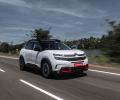
Making a debut in India with an SUV, Citroen's products in the next couple of years will clearly chart and define its destiny in what has become both a vibrant but also a daunting market for foreign entrants, says Pavan Lall.

During May, Maruti Suzuki's domestic car sales were up 2.59 per cent at 87,402 units as against 85,190 units in the same month last year.

M&M also saw its domestic passenger vehicle sales grow by 1 per cent, while Toyota Kirloskar Motor witnessed a decline in its PV sales.

Investors lost Rs 2 trillion as Sensex crashed on Tuesday.

00 hours. The overall investors' wealth, measured in terms of valuation of all listed stocks, was down by nearly Rs 6 lakh crore in early morning trade, from nearly Rs 111.44 lakh crore at the end of Tuesday's trade.

Check out the top 10 Indian bikes that rocked the sales chart for their manufacturers

Prices of two-wheelers, passenger and commercial vehicles are set to rise 15-25%

In Friday's market rally post the corporate tax cut, the country's top business promoters recouped more than two-thirds of the losses that they suffered in the post-Budget sell-off in equity markets.

As per SIAM data, vehicle sales across categories, including passenger vehicles and two-wheelers and commercial vehicles stood at 18,21,490 units last month as against 23,82,436 units in August 2018, a fall of 23.55 per cent.
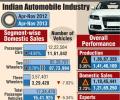
With no signs of economic revival under the current political circumstances, SIAM said it expected a turnaround in the fortune of the auto industry only after a new government is formed after the general elections next year.

Since last month, the realty (down 23%), auto (down 16%) and finance (down 14%) indices have underperformed the market by falling over 13%, as against 8% decline in the benchmark indices

Honda cars has strengthend market share in India in the past five years.

Domestic passenger vehicle sales declined 0.84 per cent to 2,63,773 units in November from 2,66,000 units in the year-ago period. Motorcycle sales, too, declined 14.87 per cent to 8,93,538 units. Vehicle sales across categories registered a decline of 12.05 per cent to 17,92,415 units from 20,38,007 units in November 2018.

While two-wheeler sales declined 22 per cent, two other segments, bigger in value while being lower in volume, were much less impacted.

The mid- and small-cap indices had a dream run between January 2017 and January 2018 - zooming 48 per cent and 56 per cent, respectively.

From being exorbitantly priced to facing stiff competition, Harley was always going to find it tough to crack a market like India, says Dhruv Munjal.

Besides, a sharp 8% decline in Chinese stocks added to the sell-off in domestic equities

Leading automakers Maruti Suzuki India, Hyundai Motor, Kia Motors and Tata Motors reported sales growth in the domestic market in November, aided by robust offtakes amid the festival season. While Maruti Suzuki India reported marginal growth, Hyundai logged in its highest ever monthly sales in November. Others like Honda Cars India, Toyota Kirloskar Motor, Mahindra & Mahindra and MG Motor India also reported sales growth in November as compared with the same month last year.
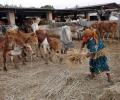
Normal monsoon makes FMCG, automobile and consumer durable companies optimistic about growth prospects

A good agricultural harvest and a timely arrival of monsoon, besides a slew of government schemes, have also come as a bounty.

The development comes after a recent notification from the Union home ministry, which has permitted companies to resume manufacturing operations and reopening of shops in red, green and orange zones with certain riders.

India's FIFA U-17 World Cup team coach Luis Norton de Matos on Saturday refused to predict his side's chances in the upcoming tournament, saying that instead of thinking about the results the country should take it as "a first step for the future".

Auto Expo's Twitter handle (@AEMotorShow), with a follower base of 16,000, is abuzz with activity. The Facebook page of Auto Expo has about 158,000 followers.

Car sales in India surged by 12.87 per cent in December.

Second body blow after diesel ban on engines of 2,000 cc and above in NCR.
